Peter Lewis correctly identifies the core threat posed by artificial intelligence: not only the risks of unregulated deployment, but the cultivated sense that citizens and societies have no meaningful say in its direction. The “inevitability doctrine” advanced by technology leaders and their political partners drains civic capacity by presenting resistance as pointless and democratic negotiation as obstruction. His declaration of “game on” is therefore well placed. Its force, however, depends on recognizing the historical and geopolitical frame in which the contest is occurring.
One of the hardest things in discussing history, technology, or world affairs with many Americans is how often the conversation is filtered through a national lens only 250 years old, shaped by a founding that included the displacement of indigenous peoples. This is not an argument about blame; it is an argument about scope. The world carried on with millennia before 1776, and civilizations have risen, fallen, and adapted through upheavals far greater than those now confronting us. Treating the present AI race as an existential contest whose terms must be set primarily in Washington therefore risks a familiar error: equating one nation’s strategic horizon with the horizon of history itself.
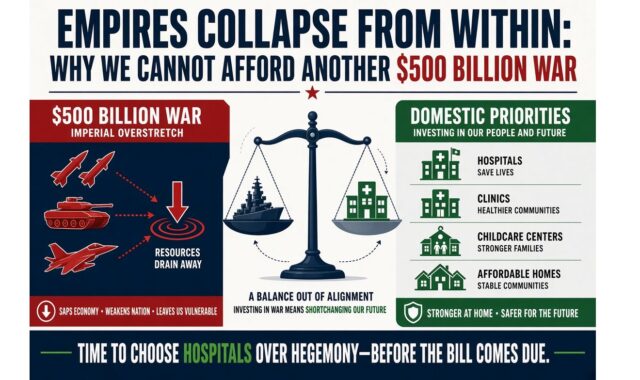
That framing carries practical consequences. Policies shaped in Washington have frequently served concentrated interests more reliably than the everyday American citizen contending with debt, healthcare costs, or stagnant wages. When every global technological or economic shift is cast as a threat to American primacy, other nations’ legitimate aspirations—for industrial capacity, energy and data sovereignty, or simply a voice in rules that will bind them—are reduced to secondary concerns. Asking the rest of the world to anchor itself indefinitely to systems that appear increasingly strained, while trust is eroded by repeated cycles of intervention, remains a difficult proposition. Affection for what the United States has represented at its best—innovation, resilience, and a measure of pluralism—need not preclude this observation. Affection should not silence it.
From the perspective of the Arab world, the situation has been shaped by the planting of Israel in its heart, the backing of coups in Syria, Iran, Egypt, and Iraq, and the support of leadership incapable of achieving even minimal development. Consequently, most of the population struggles to secure food, water, and energy. This has led to failed governments and paved the way for the formation of armies and armed gangs—fueled by the availability of cheap weapons—causing immense damage, of which there are numerous examples. Such outcomes illustrate how external interventions and the prioritization of narrow strategic interests can undermine the foundations of stable development and leave societies more vulnerable to fragmentation.
American leadership must also confront material limits. The combination of resources, institutional reach, and relative economic weight that underwrote broad dominance after the mid-twentieth century no longer exists in the same form. Debt burdens, polarized politics, and a form of capitalism that can undermine the social cohesion it claims to enrich all constrain the capacity to set unilateral terms across every domain of life. On AI, as on other transnational questions, the practical requirement is sustained cooperation among multiple powers rather than an assumption that one alliance can write the rules for everyone else. Democratic pushback inside individual countries, as Lewis describes in Australia, remains essential. It becomes more durable, however, when joined to an acceptance that no single nation—however innovative or historically significant, sets the outer boundary of what is possible or legitimate.
Change is possible. It begins with the admission that the world does not revolve around any one capital, including Washington, and that the sense of having no say is not solely a product of technology companies. It is also a product of frameworks that treat longer histories and other peoples’ interests as peripheral. Inevitability is a choice. So is the decision to treat the board as larger than the last chapter of any single nation’s rulebook.
Inevitability is a choice—but only if the game remains open to every player who must live with the outcome. Game on, on a scoreboard, older and wider than 1776.
Dr. Turki Faisal Al Rasheed Riyadh