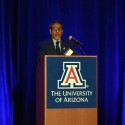
University of Arizona visit
Dr Turki Faisal Al Rasheed has recently returned from a fruitful visit to the United States, where he attended the University of Arizona’s (UA) 6th Annual Gulf Cooperation Council (GCC) UA Alumni Reunion 2016 and participated in a series of productive conferences, meetings, lectures, speeches and agricultural farm site visits.
Dr Al-Rasheed has a longstanding relationship with the University, having completed his BSc in Agricultural Engineering there, and returned in his role as a visiting professor.
The 6th Annual GCC UA Alumni Reunion 2016 highlighted a panel discussion on Climate Adaptation, Food and Water, on which Dr Al Rasheed was a panelist; it also included several other panels, comprising GCC alumni and UA faculty members. Additionally, a list of activities had been prepared, which included visits to the UA’s Biosphere 2, which is an Earth systems science research facility, the Special Collections Library, and the Mirror Lab under the Department of Astronomy and Steward Observatory. The reunion ended with a gala dinner held at the Westin La Paloma Hotel, Tucson, Arizona in honor of the GCC Alumni, and attended by – to name just a few – the UA President, Dr Ann Weaver Hart, President of Raytheon Missiles Systems, Mr Taylor Lawrence, and faculty and staff members of the University of Arizona.
Coinciding with Dr Rasheed’s visit, the Department of Agricultural and Biosystems Engineering (ABE) at the College of Agriculture and Life Sciences (CALS) sponsored a lecture on ‘The Roles of Saudi Arabia in the 21st Century Globalized World’, which was attended by ABE faculty members and graduate students.
As a board member of Mel and Enid Zuckerman College of Public Health at the University of Arizona, Dr Al Rasheed was briefed by Dean Iman Hakim on ways to progress the collaboration between Saudi institutions and the UA College of Public Health. Dr Al Rasheed reciprocated by offering his full cooperation and support for the College.
In addition to these events, the School of Middle Eastern & North African Studies (MENAS)/SISMEC had organized a lecture on the current phenomenon that we are witnessing in relation to ‘Migration and Refugees’. The lecture touched on the cause and effects of migration and refugees in the MENA region and Europe. The audience, which was composed of graduate students, professors and faculty members, was aware of the current exodus of migrants to Europe and voiced their opinion that this was due to bad governance in the migrants’ home countries.
While at the University of Arizona, Dr Al Rasheed also met with a team of scientists from the University who are working in Rwanda, and raised the possibility of establishing a philanthropic project by way of social agriculture through the UA and the University of Rwanda.
One of the highlights of the visit was made through the kind assistance of Mr. Abdulrahman Al Muhanna, President of Almarai, Saudi Arabia, who facilitated a farm visit for Dr Rasheed, Dr Kevin Fitzimmons, and Dr Joel Cuello to the state-of-the-art farming operation of Fondomonte Arizona in Vicksburg, Arizona. At the farm site, the visitors witnessed a promising agricultural farm which could boost the entire community by giving jobs to the locals, and revitalize the economy of the state.
Dr Al Rasheed argues that his social responsibility to the GCC society and MENA region is to try to achieve the UN Social Development Goals 1 & 2. This can be achieved through allocation of some of the donation money from the GCC to social agriculture, as it is one of the most effective tools for rural development, just distribution of wealth and improvements to national security. Dr Al Rasheed, together with Mr Mohammed Sharaf and the rest of the GCC supreme committee, will be assessing this further, in preparation for the next Annual GCC UA Alumni Reunion.
Additionally, Dr Al Rasheed will strongly pursue the development of the collaboration between the UA and Saudi universities and the Rwanda philanthropy project.
All in all, Dr Rasheed’s visit was a great success, paving the way for further collaboration between Saudi Arabia and other countries in addressing the UN Sustainable Development Goals and social agriculture in particular.
Leave a Reply