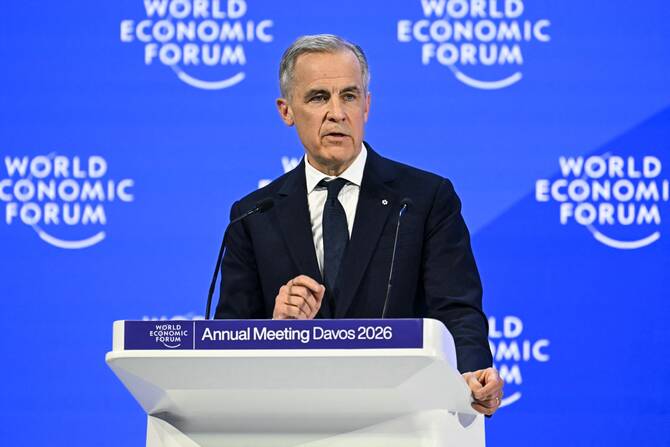
In the snow-capped Swiss town of Davos, Canadian Prime Minister Mark Carney on Tuesday delivered a speech that cut through the polite veneer of global forums. Urging leaders to abandon the “rules-based order” as mere theater, he invoked Vaclav Havel’s essay “The Power of the Powerless” to critique performative gestures like shopkeepers in Soviet-era Czechoslovakia who displayed unity slogans without conviction.
Carney’s message was stark: we are not in a smooth transition to a better world but amid a profound rupture, where economic integration has morphed into a tool of rivalry through tariffs and disrupted supply chains. For middle powers like Canada — and, by extension, nations across the Arab world — he said this demands “value-based realism,” a blend of principled action and pragmatic adaptation.
Carney’s words resonate deeply in our region, as great-power competitions echo from the Arctic to the Arabian Gulf. As the world shifts toward multipolarity, outdated Western models of aid and influence give way to self-reliant progress. Yet, amid this flux, fear often dominates the discourse, breeding disastrous outcomes.
The terminology leaders used to frame our global predicament, be it “transition,” “crisis” or “rivalry,” reveals the tangled legacy of industrialization, colonialism and now artificial intelligence’s grip on labor markets. Global warming, exacerbated by unchecked technology-driven consumption, underscores the urgency. Commercial law, once a unifier, now navigates this practical multipolarity, where AI and manufacturing promise innovation but demand equitable policies.
“Carney’s Davos address was no abstract lament. He outlined a Canadian strategy that middle powers everywhere could adapt”
Dr. Turki Faisal Al-Rasheed
This article explores these tensions through the lens of 20th-century German philosopher Carl Schmitt, whose ideas on power dynamics challenge us to confront reality without illusions. Drawing on Carney’s realism and Schmitt’s stark friend-enemy distinction, we examine how Arab nations can move beyond division to address true threats: poverty, inequality and injustice.
While Schmitt’s framework illuminates the raw edges of politics, it must not fuel fragmentation. Instead, it calls for redirecting energy toward sustainable development’s four pillars — economic growth, social justice, environmental stewardship and human capital — to build resilient societies.
Carney’s Davos address was no abstract lament. He outlined a Canadian strategy that middle powers everywhere could adapt: tax incentives to spur $1 trillion in investments across energy, AI and critical minerals; a doubling of defense spending; and fresh partnerships with the EU, China and Qatar. On Ukraine, Canada pushes coalitions for principled support; in the Arctic, it champions Greenland’s autonomy against coercive pressures; and in trade, it forges blocs that prioritize shared resilience over isolationist fortresses.
Nostalgia for a unipolar past is no strategy, Carney warned. Integration, once a bridge, now weaponizes dependencies — think US tariffs on allies or China’s supply-chain leverage. Middle powers must name this reality, act with consistency and diversify alliances to stand firm. For Arab states, squeezed between US-China frictions and regional flashpoints, this means leveraging resources like oil and renewables not for confrontation but for mutual gain. Qatar’s gas diplomacy or Saudi Arabia’s Vision 2030 investments in AI exemplify this shift, turning vulnerabilities into strengths.
Yet, as Antonio Gramsci observed, crises are not endpoints but “morbid symptoms” where old structures crumble, birthing new possibilities. In this interregnum, fear-mongering — labeling every setback an “external plot” — only deepens divides. Collective awareness and political will are essential to steer toward prosperity. Prioritizing human needs over security obsessions, we can redistribute wealth equitably, ensuring no one is left behind in the rush for innovation.
Schmitt’s enduring influence lies in stripping politics to its core: the distinction between friend and enemy. In his 1932 masterpiece “The Concept of the Political,” Schmitt argued that every domain has its opposition — morality pits good against evil, economics profit against loss — but politics alone hinges on existential stakes. The enemy is not a mere rival or disliked neighbor but a public foe, another threatening a group’s survival, potentially through lethal conflict.
This is not about morality; the enemy may even share values, yet their presence endangers one’s way of life. A border skirmish, for instance, transforms neighbors into adversaries: one sees defense, the other invasion. Leadership, Schmitt contended, demands sovereign decisions unbound by law or ethics, echoing the views of Thomas Hobbes and Niccolo Machiavelli on humanity’s volatile nature. Politics becomes the art of managing chaos: by naming the enemy, leaders forge unity, channeling passion into resolve. War, in this view, is politics intensified — a trial of collective will.
Schmitt forged these ideas in Weimar Germany’s turmoil, later tainted by his Nazi ties. Yet, abstracted from that shadow, his theory cuts through liberal optimism. He lambasted liberalism for “depoliticizing” society, recasting enemies as market competitors or forum debaters. Wars become “humanitarian” operations, rivals become trading partners. This neutralizes threats but saps vitality, assuming trade and talk can tame primal instincts. Schmitt tied this to theology: politics mirrors sacred battles of the faithful against infidels, demanding reckoning with human frailty — like original sin — before renewal.
In our hyperconnected era, Schmitt’s warning rings true. Social media amplifies rifts, while liberal inclusivity risks blinding us to real dangers. Digital echo chambers turn debates into tribal wars, eroding the shared ground needed for progress.
Contemporary thinkers like French strategist Pierre Conesa extend Schmitt’s ideas, showing how enmities are manufactured for control. In “Manufacturing the Enemy,” Conesa outlines six enemy types, each a strategic fiction with stark parallels in the Arab world.
First, the neighboring enemy thrives on proximity: Iran’s shadow over Iraq and Saudi-Yemeni border frictions mirror India and Pakistan’s Kashmir grudge. Second, the global enemy pits superpowers — US-Russia over Ukraine spills into our energy routes, much like Cold War proxies.
The intimate enemy wounds deepest in civil wars: Syria’s sectarian fractures since 2011 evoke Rwanda’s horrors, where kin become killers. The barbarian enemy revives colonial tropes — Western media once painted Algerian fighters as savages; today, Arab Spring protesters face similar smears as “chaos agents.”
Then comes the hidden enemy, fueled by conspiracies: accusations of Zionist or Western meddling in Arab uprisings deflect from homegrown woes. Finally, the media enemy weaponizes narratives — Daesh videos demonize the West; state outlets brand critics “foreign puppets.”
These archetypes politicize life but pervert Schmitt’s intent. Enmity rallies crowds, justifies crackdowns and shifts blame from leaders to phantoms. In resource-rich Arab states, economic dips trigger “infiltration” cries, masking corruption or inequality.
“In this interregnum, fear-mongering — labeling every setback an ‘external plot’ — only deepens divides”
Dr. Turki Faisal Al-Rasheed
Herein lies the peril: fabricated enemies distract from real ones embedded in daily struggles. Authoritarians summon foes to inflate patriotism, authorize repression and bury failures like graft. Post-Arab Spring, dissidents were “fifth columnists,” protests were “adversary plots.” This evades the UN Sustainable Development Goals, our clearest diagnostic.
Consider Goal 1 (No Poverty): More than 100 million Arabs live below the poverty line, as per World Bank data. Goal 2 (Zero Hunger) falters in Yemen and Sudan, where one in five faces famine. Goal 3 (Health) exposed COVID-19 gaps, with maternal mortality double the global average in spots. Goal 4 (Education) sees 20 percent female illiteracy, stifling innovation. Goal 5 (Gender Equality) battles inheritance biases and job barriers. Goal 8 (Decent Work) grapples with 25 percent youth unemployment in North Africa, spurring migration. Goal 16 (Peace and Institutions) suffers from corruption, eroding trust.
These are not fate but choices prioritizing arms over schools, elites over equity. Schmitt’s realism demands naming them: poverty as the ultimate existential threat, inequality as the hidden saboteur. By fixating on externals, we postpone Gramsci’s transformation, where crises yield justice.
Schmitt’s paradigm pierces illusions, but in the Arab world — scarred by colonialism, hooked on resources and mired in intrigues — it risks entrenching chaos, from Libya’s militias to Lebanon’s sects. The antidote? Redirect enmity inward: declare systemic neglect our collective foe. Invest in SDGs as statecraft — fund education for youth empowerment, green tech for climate resilience, fair economies for shared prosperity.
Environmental pressures and AI upheavals demand this pivot. AI and manufacturing can innovate, but only if policies honor diverse needs, ditching Western aid traps for self-driven growth. Leaders must embody Carney’s value-based realism: pragmatic deals with foes-turned-partners, like EU pacts or Chinese infrastructure, while upholding justice.
As Gramsci urged, let’s seize this interregnum for renewal. Collective will builds sustainable pillars, reducing inequalities and humanizing progress. In unity over division, the Arab world transcends fragmentation. Let politics build, not break, declaring poverty the enemy we slay together. This forges something bigger, juster: a horizon of flourishment for all.
Prefer watching over reading? View the full article in video form at the link below.
Value-Based Realism: How Arab Nations Can Defeat Poverty, Not Phantoms (Video Overview)
Realistic Unity in a Divided World: From Schmitt & Carney to Arab Resilience (Audio Overview)
Leave a Reply