A Historic Decline in Dust Storms: Saudi Arabia’s Environmental Transformation and Cleaner Skies
Dr. Turki Faisal Al Rasheed
Arab News | July 16, 2026
In the arid landscapes of the Arabian Peninsula, dust and sandstorms have long been a defining feature of life, shaping ecosystems, challenging infrastructure, and affecting public health for centuries. Yet recent data from the National Center of Meteorology (NCM) signals a remarkable shift. In June 2026, the Kingdom of Saudi Arabia recorded a near-zero incidence of dust and sandstorms — the lowest in more than 25 years — with an average decline of 99 percent compared to historical rates. This development, documented in a report by the Regional Center for Dust and Sandstorms, represents not only a climatic anomaly but a tangible outcome of sustained national efforts under Vision 2030.
From Dust Clouds to Clearer Skies: Saudi Arabia’s 99% Victory Over a Desert Legacy.
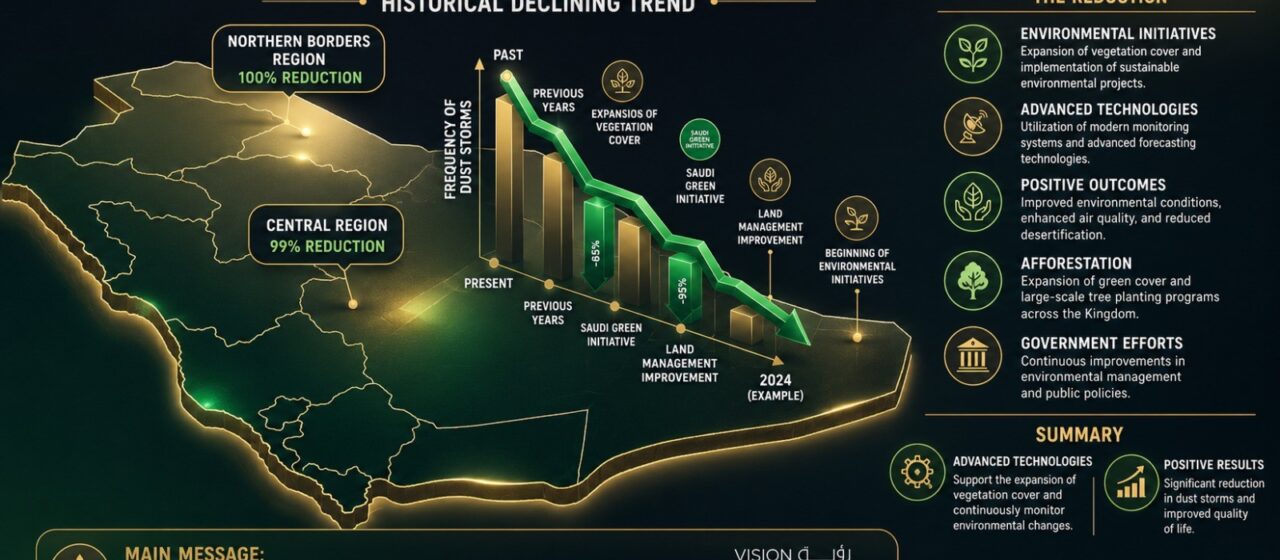
Description of the Infographic: “Reduction in Dust Storms – Historical Declining Trend” The infographic features a stylized map of Saudi Arabia highlighting a 100 percent reduction in the Northern Borders Region and a 99 percent reduction in the Central Region. A prominent graph traces the historical decline in dust-storm frequency, with tall bars for previous high-activity years descending sharply through key milestones: expansion of vegetation cover, the Saudi Green Initiative, land-management improvements, and recent achievements. A steep green downward arrow underscores dramatic reductions.
The right-side panel details “Key Factors Behind the Reduction,” including environmental initiatives (such as the Saudi Green Initiative and vegetation expansion), advanced technologies, afforestation, and government efforts. The summary and main message emphasize cleaner air, improved quality of life, and alignment with Vision 2030.
Understanding the Data: A Quantitative Leap Forward The Regional Center’s June 2026 report details strong regional results. The Northern Borders achieved a full 100 percent decline, while the Central Region (Riyadh, Qassim, Al-Kharj) and Eastern Region (Al-Ahsa, Dammam, Dhahran) each recorded a 99 percent drop. This marks the lowest dust activity in over 25 years of monitoring.
Historically, dust storms were far more prevalent. Data from earlier decades (1978–2010 and peaks in the 1990s) show frequent events, especially at northern and eastern stations, often exceeding dozens per year at key sites. Progressive improvements in recent years (approximately 50 percent reductions in 2025) culminated in the exceptional June 2026 figures. The graph captures this long-term downward trajectory effectively.
Comparative Perspective: Arizona’s Recent Dust Storm For context, arid regions elsewhere continue to face significant dust challenges. On July 12, 2026, Arizona’s monsoon season began with a powerful dust storm (commonly called a haboob) that impacted Phoenix and surrounding areas. Classified as moderately strong by Arizona State University researchers, the event brought heavy dust, rain, and wind gusts up to 39 mph, reducing visibility on major freeways such as Interstate 10 and lasting about four hours. The Arizona Department of Transportation activated dust-detection sensors and lowered speed limits for safety, while residents were advised to pull off the road. Community resilience was evident as neighbors supported recovery efforts. Such events highlight the ongoing vulnerabilities of desert environments that lack comparable large-scale vegetation and land-management interventions.
Drivers of Change: The Saudi Green Initiative, Cloud Seeding, and Complementary Efforts The sharp decline in the Kingdom stems from a powerful combination of environmental and climatic factors, prominently featured in the infographic. Central among them is the Saudi Green Initiative (SGI), a cornerstone of Vision 2030. SGI drives large-scale afforestation (targeting 10 billion trees), land restoration across millions of hectares, expansion of vegetation cover, and the establishment of protected reserves. These measures stabilize soils, reduce erosion sources, and enhance ecosystem resilience.
Complementing SGI is the national cloud-seeding program, which enhances rainfall to support vegetation growth and soil moisture in arid zones. Additional contributors include regulated grazing to prevent overgrazing, advanced monitoring technologies (satellite data, LiDAR, AERONET systems, and predictive models), and weaker air fronts during the period. The infographic explicitly links these elements — environmental initiatives, afforestation, and government policies — to the observed reductions.
In my book Saudi Arabia’s Transformation: Uncertainty and Sustainability (Routledge, 2026), I provide an in-depth analysis of these strategies. The work highlights how Vision 2030 integrates sustainability with development to address arid-land challenges, including land degradation and the food-water-security nexus, with initiatives such as the Saudi Green Initiative and cloud seeding serving as vital pillars of resilience.
Vision 2030 in Action: Where Once Dust Storms Ruled, Green Hope Now Prevails.
Broader Impacts: Health, Economy, and Society The infographic’s “Positive Outcomes” section summarizes the benefits: improved air quality, reduced respiratory-health risks, enhanced biodiversity, and fewer disruptions to transportation, agriculture, and economic activities. These gains support broader goals of environmental sustainability and quality of life.
Challenges and the Path Ahead While the infographic celebrates this progress, sustained efforts remain essential to address regional dust sources, climate variability, and long-term resilience. Continued investment in the Saudi Green Initiative, cloud seeding, monitoring technologies, and international cooperation will be vital.
Conclusion The historic decline in dust storms, powerfully illustrated in the infographic and contrasted with events such as Arizona’s recent monsoon dust storm, stands as compelling evidence of Saudi Arabia’s environmental leadership. Through the Saudi Green Initiative, cloud seeding, afforestation, advanced technologies, and strategic land management — as examined in my work — the Kingdom is delivering measurable results aligned with Vision 2030. This achievement not only brings clearer skies but also offers a replicable model for other arid nations. Ongoing commitment will ensure these gains endure, fostering a greener, more sustainable future for generations to come.
Beyond the dust: Saudi Arabia’s environmental transformation
Prefer watching instead of reading? Click here to watch the video version of this article.