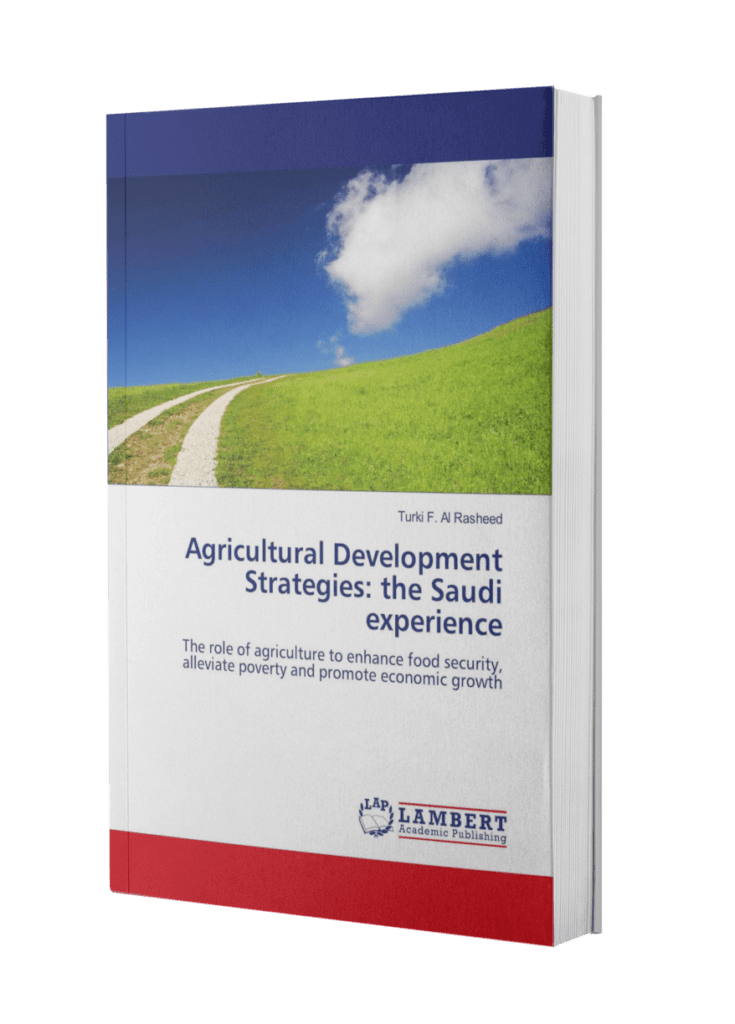
The role of agriculture to enhance food security, alleviate poverty, and promote economic growth
Second Edition
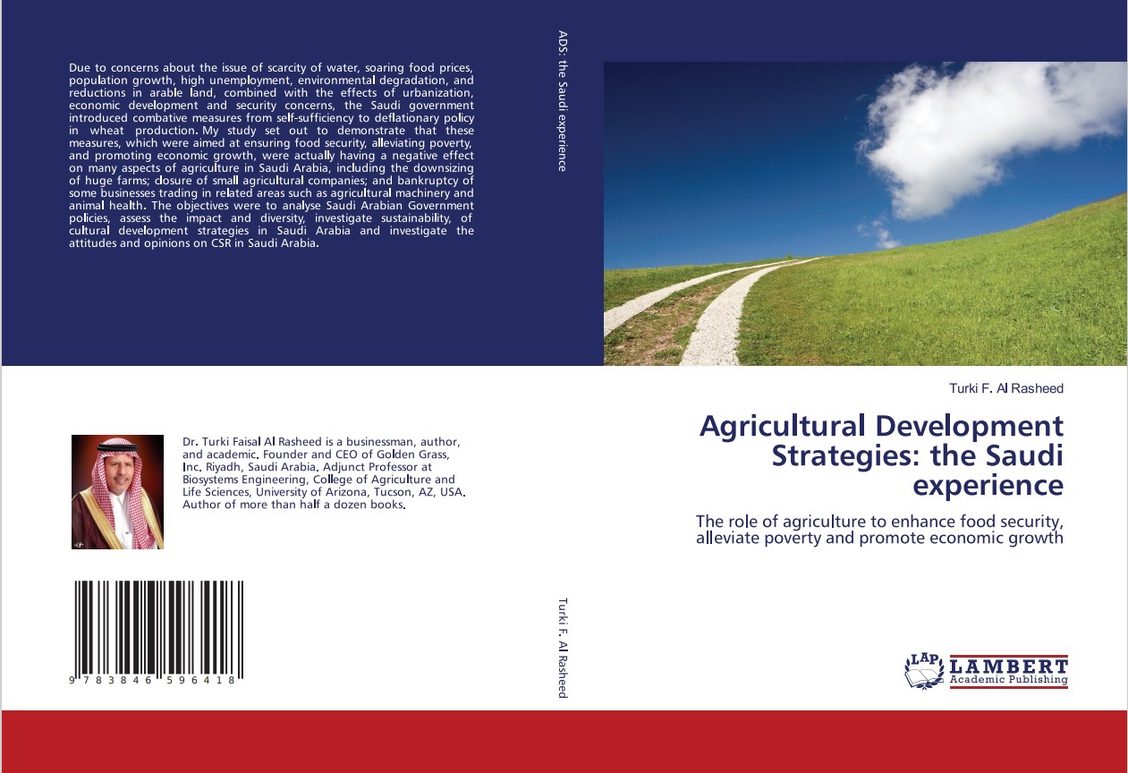
The current food crisis, including increasing prices of basic food commodities and hunger shortages worldwide, due to the COVID-19 pandemic and the Russia–Ukraine war have triggered the disruption of the food supply chain. This disturbance has prompted me to re-introduce my book: the second print is titled Agricultural Development Strategies: The Saudi Experience, with a subtitle of the role of agriculture to enhance food security, alleviate poverty, and promote economic growth.
The government of Saudi Arabia has raised questions about the long-term prospects of food security, alleviating poverty, and economic growth. The issues of scarcity of water, soaring food prices, population growth, high unemployment, environmental degradation, and reductions in arable land combined with the effects of urbanization, economic development, and security concerns have led to measures from self-sufficiency to deflationary policy in wheat production.
This book aims to show that there is no clear policy understanding of how deflationary policies impact at both the macro and micro levels. It proposes both a theoretical framework and practical analysis of the use and implementation of agricultural development strategies (ADSs) in Saudi Arabia. Furthermore, the book develops an intricate conceptual framework to understand the role of agriculture in achieving sustainable development in Saudi Arabia.
The book also aims to inform the development of agricultural policies and strategies, and suggest ways that future policies and strategies can be most effectively formulated, for example, to enhance the role of agriculture by increasing economic welfare in areas such as income, employment, basic education, quality of life, health, and the preservation of natural resources.
The findings of this book demonstrate the importance of developing water optimization schemes, establishing a national research and information center, using new technological innovation, and recognizing the needs of agencies for marketing of agricultural products, and refer to governmental and private organizations’ corporate social responsibility and stakeholder interest for the development of ADSs.
The book develops a conceptual framework that reveals that the heterogeneity in agro-climatic environments implies that no single ADS can be applied in all regions of Saudi Arabia in a uniform manner. It is also important to note that, while ADS may seem useful today, it may not be useful tomorrow; therefore, continuous awareness and monitoring is required to evaluate its effectiveness.
Agricultural Development Strategies suggests that further study should be conducted on the 13 provinces of Saudi Arabia for the suitability of the agro-climatic environments. More research is required into e-government (training, distance learning, and supervision), extension services, seed suitability, and the compatibility of Arab or Muslim or Asian countries to Saudi Arabia.
The book is oriented towards the intricate development of agricultural development strategies in Saudi Arabia. It includes the formulation of strategies for the enhancement of food security, the alleviation of poverty, and the promotion of economic growth. It does not address the specifics of ADSs for each region or offer details on each sector, namely food security, alleviation of poverty, and promotion of economic growth.
The book is available from all major book outlets and can be ordered onlinehttps://www.omniscriptum.com/turki-f-al-rasheed/
Leave a Reply