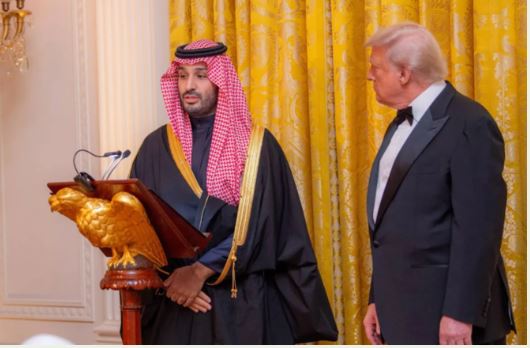
As a seventh-generation steward of Saudi Arabia’s legacy, I pen these reflections with profound gratitude for the enduring bond between my homeland and the US, a connection that first drew me to American shores in the mid-1970s as a scholarship student. Today, in November 2025, that alliance gleams anew under President Donald Trump’s second term, illuminated by Crown Prince Mohammed bin Salman’s first White House visit in seven years.
In a candid Oval Office exchange with Arab News Editor-in-Chief Faisal Abbas, Trump invoked his own sleepless nights, driven by a vision to “make America great again,” and drew a poignant parallel to Crown Prince Mohammed bin Salman: “The crown prince thinks about his country, and I think about mine.” He lauded their shared tenacity, saying: “Trump is stubborn in his dream for America, and Mohammed bin Salman is stubborn in his dream for Saudi Arabia,” adding that “the future is made by dreamers, especially when they possess the ability to bolster their dreams with numbers.”
These words encapsulate a partnership rooted in aligned ambitions: Saudi Arabia’s Vision 2030 and America’s innovative edge, converging to navigate a multipolar world. Far from transactional oil-and-arms deals, this recalibration prioritizes technological sovereignty, regional stability, and global prosperity, offering a rational counter to conflict profiteers who thrive on the Arab world’s unmet basic needs.
On Nov. 18, 2025, against the crisp autumn backdrop of Washington, the crown prince’s arrival transcended protocol, unveiling a blueprint for collaborative progress. The centerpiece was the Strategic Artificial Intelligence Partnership, inked by US Secretary of State Marco Rubio and Saudi Foreign Minister Prince Faisal bin Farhan. This accord, backed by a $1 trillion Saudi pledge in US sectors such as rare earth minerals, nuclear energy, and semiconductors, heralds a pivot from energy security to tech interdependence.
Saudi Arabia, with its Neom megacity and burgeoning AI hubs, bridges Eastern ingenuity and Western computational might. The US, leveraging Silicon Valley giants such as Nvidia and Elon Musk’s xAI, contributes expertise in model training and ethical governance. As the crown prince noted during the joint presser, these ventures yield “benefits for both the US and Saudi Arabia, and indeed the world.”
This alliance elevates AI beyond bilateral gains, positioning it as a catalyst for humanity’s shared challenges. In an age in which algorithms can either amplify potential or entrench divides, the pact embeds safeguards for transparency and inclusivity. Tools forged here are climate models for drought-resistant crops, predictive analytics for pandemics, and equitable platforms for remote education addressing existential threats head-on.
Economically, it sparks prosperity: Saudi Arabia’s Humain AI partnering with xAI on data centers could create thousands of high-skill jobs, integrating the Kingdom into the global digital economy.
Culturally, it mends historical rifts, proving innovation’s power to foster trust. Trump’s endorsement “honoring Saudi Arabia and the crown prince” through deals that “make America and the world greater” underscores a symbiotic model. By intertwining supply chains in chips and cloud infrastructure, such ties deter aggression: Isolation becomes economically ruinous, reducing proxy war incentives, and paving a prosperous path for the Middle East.
Yet, this technological synergy gains urgency amid cascading conflicts, where AI emerges as a peace multiplier. The visit spotlighted Riyadh’s diplomatic push to end wars in Sudan and Syria, amplified by US support. In Sudan, two years of civil strife have displaced millions and scorched ecosystems; the crown prince urged Trump to advance the 2023 Jeddah Declaration, co-mediated by Riyadh and Washington. A September 2025 Saudi-US Arab League-Egypt roadmap charts ceasefires and power-sharing, unlocking $10 billion in reconstruction for reforestation and water restoration.
“Riyadh is setting a new standard for peace and global diplomacy, channeling resources toward reconciliation over rivalry.”
Dr. Turki Faisal Al-Rasheed
In Syria, post-Assad stabilization led by Saudi-hosted economic forums since early 2025 aligns rebuilding with Vision 2030’s sustainability goals, restoring farmlands and enabling refugee returns. These efforts, extending to Gaza ceasefires and even Russia-Ukraine dialogues, yield peace dividends: slashed emissions from halted bombings, mine-free agriculture, and stabilized populations.
AI supercharges this agenda. Saudi-US tools could analyze satellite data for real-time ceasefire monitoring or deploy natural language processing to streamline Jeddah negotiations. By quelling violence, the partnership enables sustainable tech deployment of AI-optimized solar grids in Sudan or hydrology models for Syria’s Euphrates, ensuring progress honors the planet. As one media outlet observed: Riyadh is “setting a new standard for peace and global diplomacy,” channeling resources toward reconciliation over rivalry.
This momentum unfolds against a fraught geopolitical canvas, shaped by three clashing forces. First, status-quo guardians such as Israeli Prime Minister Benjamin Netanyahu, with his brinkmanship, buoyed by the US military-industrial complex clinging to ironclad pacts, perpetuate cycles of violence that drain negotiation coffers. The Oct. 7, 2023, Hamas attacks, Iran’s June 2025 strike on Qatar’s Al-Udeid base, with US foreknowledge, and Israel’s September airstrike on Doha exposed alliance fractures: Israel’s Gaza quagmire yielded no decisive wins, while US isolation deepened at the UN and across Arab capitals. Decades of Washington tilting toward Israeli primacy have sustained authoritarian proxies and instability, leaving Arab populations to ration basics amid ideological extremism.
Second, multipolarity surges via China’s Belt and Road and Russia’s BRICS, promising equitable governance but risking debt and authoritarian sway.
Third, Saudi Arabia’s reforms, women’s workforce gains, kafala overhauls, religious tolerance, and AI-defense synergies bet on de-escalation and diversification. The 2023 Tehran detente, frozen Israel normalization pending a two-state solution, and a Pakistan defense pact enhance Riyadh’s leverage, blending deterrence with development.
Critics decry human rights lapses or oil reliance, valid concerns overshadowed by selective outrage. US media fixates on the 2018 Khashoggi killing as Riyadh’s “singular moral stain,” yet mutters faintly on American precedents: Madeleine Albright deeming 500,000 Iraqi child deaths “worth it,” Colin Powell’s fabricated UN vial, or Dick Cheney’s deceptions igniting a million-civilian toll in Iraq. Those perpetrators earned eulogies and fees, not perpetual scorn. This is not journalism, but selective etiquette thundering against foreign princes, while whispering over homeland war crimes in Afghanistan, Yemen, and Palestine.
Even the touted F-35 deal draws scrutiny. Dubbed a boon for Riyadh, this $400 million-per-plane behemoth is a maintenance nightmare. Cheaper, proven alternatives from Russia — Su-35, Su-57 — or China — J-20, FC-31 — evade US vetoes on repairs. It is a gold-plated lemon for American contractors’ delight, not strategic savvy.
The crown prince’s visit, then, demands candor on proxy playgrounds such as Syria, where Western erosion compels reckoning with the roots of violence. By surmounting congressional hawks and American Israel Public Affairs Committee snares securing semiconductors, nuclear access, and cloud tech, Trump can validate Riyadh as a GCC anchor and US guarantor, not puppeteer.
In foreign policy’s sausage-making haze, this pact whispers a bolder equation: shared code for common cause. As dreamers such as the crown prince and Trump align numbers with vision, Saudi-US ties may yet create algorithms for a harmonious future rooted in trust, propelled by AI, and redeemed by peace.
Saudi-US AI Diplomacy: Crown Prince MBS’s 2025 White House Pivot – From Oil to Tech Sovereignty & Peace Innovation (Video Overview)
Saudi-US AI Diplomacy: Crown Prince MBS’s 2025 White House Pivot – From Oil to Tech Sovereignty & Peace Innovation (Audio Overview)